
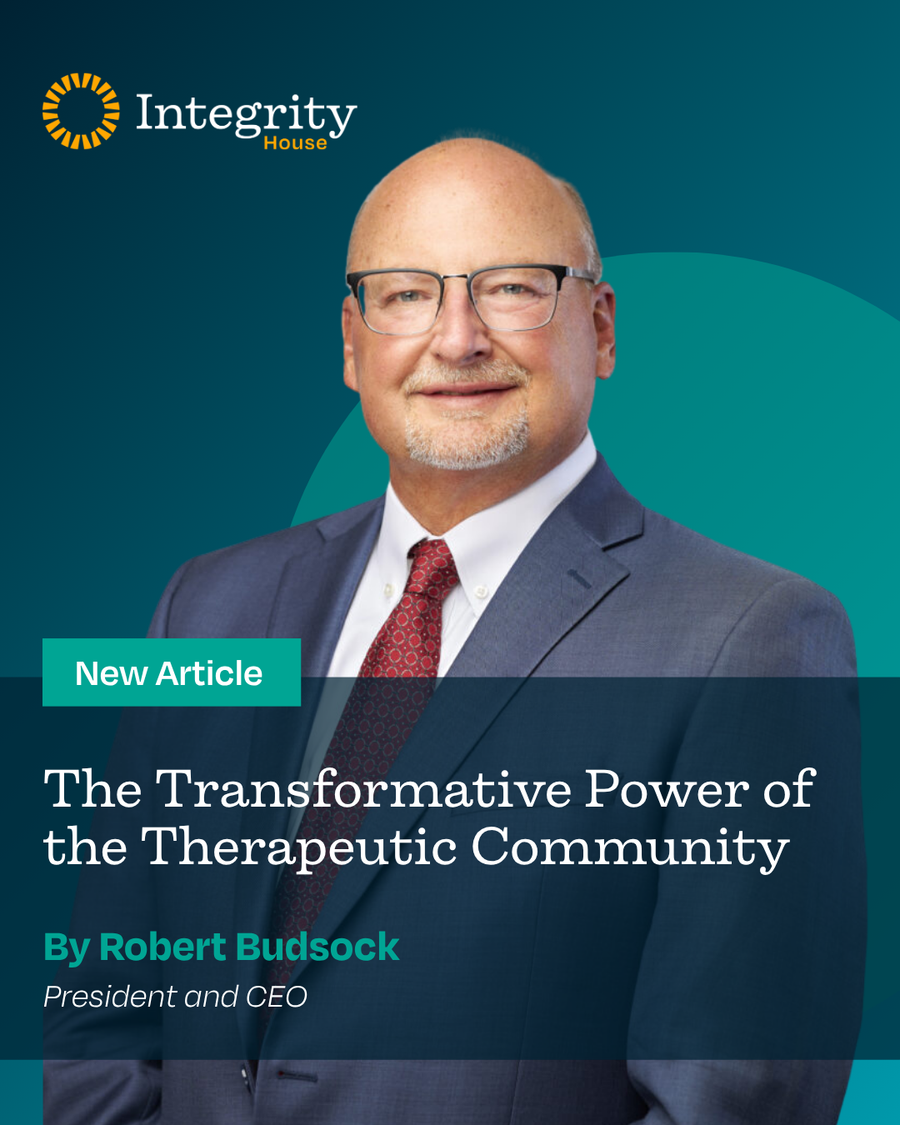
By Robert J. Budsock, President & CEO, Integrity House
In my four decades at Integrity House, I have watched the needs of people entering treatment change considerably. People today are presenting with more complex mental health and medical needs, new substances and challenges have emerged, and our understanding of addiction has grown considerably.
Despite these changes, the foundation of effective addiction treatment remains the same. Lasting recovery requires a whole-person approach that helps individuals develop healthier behaviors, strengthen relationships and build more stable, fulfilling lives.
Therapeutic communities have been helping people achieve and sustain recovery for more than 70 years. Their strength lies in combining a whole-person approach with structure, accountability, peer support and repeated opportunities to practice new behaviors. Together, these elements can help people develop the skills and habits necessary for sustainable lifestyle change and long-term recovery.
What is the therapeutic community model?
A therapeutic community, or TC, is a treatment model in which the community itself is an essential part of the treatment process. Often described as “community as method,” the model draws on relationships, shared responsibilities, peer feedback, accountability and participation in daily community living to support individual change. While helping individuals stop using substances is an important first step, sustaining recovery requires a deeper transformation. Through the therapeutic community model, individuals develop healthier ways of thinking, behaving and relating to others, building the skills and habits necessary to create meaningful, lasting change in their lives.
Structure is an important part of that process. People entering treatment typically need an environment where expectations are clear, responsibilities are defined and there are consistent opportunities to practice new behaviors. Within the TC, those behaviors are reinforced through peer relationships, community responsibilities, counseling and daily interactions.
In other words, the therapeutic community provides both the structure to support change and the environment in which people can practice it.
How behavior becomes habit
Much of the behavioral change that occurs in a TC takes place through the routines and responsibilities of daily life. At Integrity House, residents have household and community responsibilities that contribute to the overall program. They are also expected to show up on time, communicate with others, accept feedback, manage frustration, resolve conflict, and follow through on commitments.
Becoming more accountable, learning to manage frustration, controlling impulses and asking for help all require repeated opportunities to put those behaviors into practice. For individuals accustomed to seeking immediate gratification through substance use, recovery also involves learning to make thoughtful decisions, work toward long-term goals and recognize the rewards of sustained effort. In a TC, these behaviors are reinforced through shared responsibilities, peer accountability and social learning. Over time, individuals begin to recognize how their choices affect themselves and others, developing the patience, discipline and sense of responsibility needed to sustain lasting change.
Over time, people can develop habits they can carry with them after treatment: successfully completing a task, accepting guidance and support, helping others, and following through even when motivation is low.
These are practical skills for recovery because they are also practical and essential skills for life.
Recovery requires practice and time
People do not enter treatment with every skill, relationship and behavior necessary to sustain recovery. Early in treatment, someone may need considerable structure and guidance. As they progress, responsibilities increase, greater independence follows demonstrated growth, and peers who once received guidance begin providing it to newer members of the community. This progression gives people opportunities to practice new ways of thinking, behaving and relating to others while gradually taking greater ownership of their recovery.
We encourage that progression within Integrity House’s own continuum of care. As individuals build recovery capital, including the skills, relationships, resources and stability that support long-term recovery, their need for intensive treatment gradually decreases. Someone who is doing well in the therapeutic community can move to a less intensive residential setting, where they continue living in a structured treatment environment while beginning to work or attend school in the community. Once they have secured safe and affordable housing and are ready for greater independence, they can transition to outpatient treatment. As recovery capital grows, the intensity of services decreases, allowing individuals to take on greater independence while remaining connected to the support they need to sustain their progress.
Research also supports the value of sustained participation in a TC. A 2020 study examining outcomes following therapeutic community treatment found sustained improvements in substance use, well-being, psychiatric symptoms, social functioning and employment nine months after treatment. Participants who remained in the therapeutic community longer generally experienced better outcomes, with those who stayed at least nine months reporting greater reductions in drug use than those who stayed for shorter periods. The findings reinforce that behavioral change takes time, and sustained participation provides more opportunities to strengthen the skills and behaviors that support recovery.
A model designed to adapt
The therapeutic community has evolved alongside the people and challenges it serves. While its fundamental principles remain consistent, the model can be adapted across populations, settings and forms of addiction, including substance use disorders, alcohol misuse, gambling disorders and other behavioral addictions.
The World Federation of Therapeutic Communities’ 2026 Genoa Manifesto describes the TC as “a learning environment for life and a place to begin again,” adaptable to individual needs and “perpetually evolving to meet changing times and conditions.” The manifesto emphasizes attentiveness to the whole person and to “the life beneath the symptom.”
At Integrity House, that focus on whole-person care has meant addressing the mental health, physical, social, and economic needs of our clients. Depending on the individual, that might look like: GED instruction or help applying to postsecondary education programs; workforce readiness, occupational training, and job placement; onsite primary care services and care coordination for chronic, co-occurring health conditions; or assistance securing important identification and public benefits. These services can be incorporated while the community continues to provide structure, accountability, peer support and opportunities for behavioral change.
We have also adapted the model for people involved in the justice system. At the Hudson County Correctional and Rehabilitation Center, Integrity House operates a 240-bed program serving approximately 500 incarcerated adults each year. Treatment responds to the realities of incarceration and reentry while maintaining the TC’s focus on responsibility, behavior change, peer accountability and preparation for life in the community.
There is no single profile of a person with an addiction. The strength of the TC is its ability to respond to different needs and circumstances while preserving the principles that make the community therapeutic.
Preparing people for life beyond treatment
The purpose of the therapeutic community is ultimately to help people function more successfully outside of treatment. The skills developed in treatment are designed to help people navigate their lives within families, workplaces and communities.
Treatment should help someone understand what needs to change while also giving them the time, structure and support to practice living differently. That is the transformative power of the therapeutic community: helping people build changes they can carry with them long after treatment ends.